
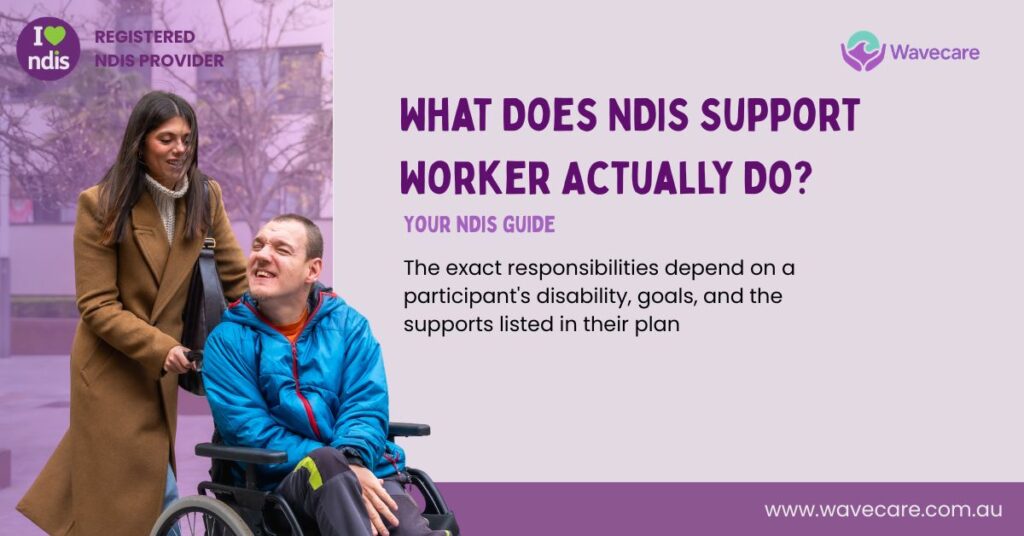
What Is an NDIS Support Worker?
An NDIS support worker is a trained professional funded through Australia’s National Disability Insurance Scheme (NDIS) who assists people with disability to live as independently and fully as possible. They provide hands-on help with daily tasks, personal care, community access, and skill-building — all tailored to the individual’s goals and NDIS plan.
If you or someone you love has recently received an NDIS plan, you’ve likely come across the term “support worker” more than once. But what does a support worker actually do day to day? And how do you know if the support they offer is right for your situation?
A support worker’s role is far broader — and more personal — than most people initially realise. They’re not just there to help someone get dressed in the morning or take medication. They’re a consistent, trusted presence that helps participants build confidence, engage with their community, and move closer to the life they want to live.
This guide breaks down exactly what NDIS support workers do, the types of support available under the NDIS, and what to look for when choosing support services in Victoria.
What Are the Core Responsibilities of an NDIS Support Worker?
NDIS support workers assist with personal care, household tasks, medical appointments, community access, skill development, and emotional support. Their specific duties are guided by the participant’s individual NDIS plan and personal goals.
Support workers wear many hats. The exact responsibilities depend on a participant’s disability, goals, and the supports listed in their plan — but broadly, a qualified disability support worker in Victoria will help with:
- Personal care — Bathing, grooming, dressing, continence management, and other hygiene-related tasks
- Meal preparation and nutrition — Cooking, feeding assistance, and managing dietary needs
- Medication prompting and management — Reminders and support (not administration by unqualified workers)
- Household tasks — Cleaning, laundry, and maintaining a safe living environment
- Transport and mobility — Driving participants to appointments, social activities, and work
- Community participation — Accompanying participants to social events, sports, classes, or religious activities
- Skill-building — Teaching independent living skills like budgeting, cooking, or using public transport
- Emotional and social support — Providing companionship, reducing isolation, and encouraging positive wellbeing
- Plan support coordination — Helping participants understand and use their NDIS funding effectively
It’s worth noting that a good support worker isn’t there to do everything for you — they’re there to help you do as much as you’re able, in the way that works best for you.
What Types of NDIS Support Services Are Available?
NDIS supports are categorised under specific funding lines called Support Categories. Understanding these categories helps participants know what their plan can cover and how a support worker fits into each area.
Support Category
What it Covers?
Support Worker Involvement
Daily Activities
Personal care, household tasks, meal prep
High — core day-to-day assistance
Social & Community Participation
Community access, social activities, recreational programs
High — escorts, accompaniment, facilitation
Improved Daily Living
Skill-building, therapy, training for independence
Moderate — skill development sessions
Support Coordination
Navigating the NDIS, connecting with providers
Indirect — support coordinators assist here
Transport
Getting to appointments, work, and activities
Direct — support workers provide transport
Assistance with Social & Civic Participation
Volunteering, civic engagement, community programs
Direct accompaniment and facilitation
Your NDIS plan will specify how much funding is available in each category. A support worker helps you draw on those funds in ways that are meaningful and goal-aligned.
How Do NDIS Support Workers Help With Personal Care and Daily Living?
Personal care support involves hands-on assistance with bathing, dressing, grooming, eating, and toileting. Daily living assistance extends to household management, meal preparation, and maintaining a safe home environment — all delivered with dignity and respect for the participant’s preferences.
Personal Care Support
For many NDIS participants, personal care support is the most frequently used service. It covers all aspects of hygiene and physical care that a person may need help with due to their disability. This includes:
- Showering, bathing, and personal hygiene routines
- Dressing and undressing, including managing adaptive clothing or aids
- Grooming — hair care, shaving, skincare
- Oral hygiene and dental care support
- Continence support and toileting assistance
- Positioning and transfers (e.g., from bed to wheelchair)
- Feeding support for those with swallowing or motor difficulties
Dignity and choice are central to how personal care is delivered. A quality support worker will always explain what they’re doing, respect boundaries, and adapt their approach to the person’s preferences and cultural background.
Daily Living Assistance
Beyond personal care, daily living assistance helps participants maintain a functional, comfortable home environment. This is particularly important for people who live independently or with family carers who need respite. Support can include:
- Grocery shopping and meal planning
- Cooking meals that meet dietary requirements
- Household cleaning and laundry
- Managing bills, correspondence, and appointments
- Pet care assistance
- Home safety checks and hazard management
Good to Know: Under the NDIS, in-home disability support is designed to be flexible and person-centred. This means your support worker adapts to your routine — not the other way around. If you prefer to shower in the evening, eat at a certain time, or have a specific way you like tasks done, a good support worker will honour that.
How Do Support Workers Help With Community Participation?
Community participation support helps NDIS participants engage with social, recreational, cultural, and civic activities in their local area. A support worker may accompany the participant, provide transport, offer on-the-spot assistance, or help them build the confidence and skills to participate more independently over time.
Social connection and community involvement are central to wellbeing — and for many people with disability, they’re also among the hardest things to access without support.
An NDIS support worker can help with community participation in a range of ways:
- Accompanying participants to social events — Birthdays, sporting events, community festivals, cultural gatherings, or religious services
- Supporting access to recreational activities — Swimming, art classes, gym sessions, or group programs
- Facilitating friendships — Helping participants meet new people and maintain relationships
- Assisting with education and employment — Supporting access to TAFE, university, or workplace environments
- Navigating public spaces — Public transport, shopping centres, parks, and community facilities
- Building social confidence — Practising conversation, social scripts, or managing sensory environments
For participants working toward greater independence, community participation support is often gradual — starting with one-on-one accompaniment and slowly transitioning to supported group activities and eventually independent engagement.
What Does Independent Living Support Look Like Under the NDIS?
Independent living support helps NDIS participants develop the skills, routines, and confidence needed to live as independently as possible — whether that’s in their own home, shared accommodation, or Supported Independent Living (SIL). It’s about building capacity, not creating reliance.
One of the most important — and often misunderstood — aspects of the NDIS is that supports are designed to build independence over time, not maintain dependency.
Independent living support under the NDIS can include:
- Skill development sessions — Learning to cook, manage money, use public transport, or maintain a tenancy
- Supported Independent Living (SIL) — 24/7 or part-time staffed accommodation for those with higher support needs
- Individualised Living Options (ILO) — Flexible, tailored home and living arrangements
- Assistance with Supported Decision Making — Helping participants understand choices and make informed decisions about their own life
Overnight and active night support — For participants who need assistance or monitoring during night hours
What's the Difference Between SDA and SIL?
Specialist Disability Accommodation (SDA) refers to the physical home or building — the bricks and mortar — specifically designed for people with extreme functional impairment or very high support needs.
Supported Independent Living (SIL) is the support provided within that home — the people who assist residents day to day. They are distinct NDIS supports, funded separately, though they often work hand in hand.
How Is an NDIS Support Worker Different From Other Disability Care Roles?
The disability care sector uses a range of titles that can cause confusion. Here’s a clear breakdown:
Role
Focus Area
Qualification Level
NDIS Funded?
NDIS Support Worker
Daily living, personal care, community access
Cert III or IV in Individual Support
Yes
Support Coordinator
Plan navigation, provider connections
Diploma+ or extensive experience
Yes (Separate Line)
Disability Support Nurse
Clinical care, complex health needs
Registered or enrolled nurse
Yes (Clinical Line)
Allied Health Professional
Therapy (OT, physio, speech pathology)
Degree qualified
Yes (Capacity Building)
Plan Manager
NDIS budget and invoice management
Financial Background
Yes (Separate Line)
Career/ Family/ Carer
Informal support from family/friends
No Formal Qualification Required
Limited (self-managed plans)
Understanding these distinctions matters — especially when building a support team that works across your different goals and needs. A support worker is typically your day-to-day person, while coordinators, planners, and therapists play complementary roles in the background.
How Do You Find a Quality NDIS Support Worker in Victoria?
Finding the right support worker is one of the most personal decisions an NDIS participant makes. In Victoria, participants can access support workers through:
- Registered NDIS providers — Organisations registered with the NDIS Quality and Safeguards Commission and employing vetted workers
- The NDIS Provider Finder — The official search tool on ndis.gov.au for finding registered providers near you
- Disability support agencies in Victoria — Local providers with specialised knowledge of services and community networks in your area
- Direct employment (self-managed or plan-managed) — Participants can hire their own support workers independently if their plan allows
What Should You Look for in a Support Worker?
Beyond qualifications and police checks, the best support workers share certain qualities that make a real difference:
- Genuine respect for the person’s autonomy — They listen, follow your lead, and never impose their preferences
- Consistent reliability — They show up on time, follow through on commitments, and communicate clearly if plans change
- Cultural awareness and sensitivity — Particularly important in Victoria’s diverse communities, including First Nations and CALD participants
- Patience and emotional intelligence — Disability support is relationship-based work; emotional attunement matters enormously
- Appropriate mandatory checks — NDIS Worker Screening Check, Working with Children Check (where applicable), and current First Aid certification
NDIS Worker Screening: All paid NDIS support workers in Victoria must hold a valid NDIS Worker Screening Check — a national background check that assesses whether a person poses a risk to people with disability. This is different from a standard police check and is mandatory under the NDIS Commission’s Practice Standards.
Questions to Ask a Potential Support Provider
- How do you match support workers to participants?
- What happens if my regular support worker is sick or unavailable?
- Are your workers trained in my specific disability type?
- How do you handle feedback or complaints?
- Can I trial the service before committing?
Frequently Asked Questions
What qualifications does an NDIS support worker need in Victoria?
Most NDIS support workers hold a Certificate III in Individual Support (Disability) or a Certificate IV in Disability. However, qualifications alone don’t tell the whole story — experience, personality fit, and mandatory checks (NDIS Worker Screening, First Aid) are equally important. Some specialised roles, such as complex health care support, require higher-level clinical qualifications.
Can I choose my own NDIS support worker?
Yes. Under the NDIS, participant choice and control is a core principle. You can request a specific worker from a provider, hire your own worker directly (if self-managed or plan-managed), or switch providers if you’re not satisfied. You always have the right to say no to a worker who doesn’t feel like the right fit.
How many hours of support worker time does an NDIS plan typically fund?
This varies widely and depends entirely on individual needs and goals. Some participants receive a few hours per week for community access support, while others with higher daily living or personal care needs may receive many hours per day. Your Support Coordinator or Local Area Coordinator (LAC) can help you understand what your specific plan allows.
What is the difference between an NDIS support worker and a carer?
A paid NDIS support worker is a professional employed to provide specific, goal-oriented disability support. A carer is typically an informal, unpaid supporter — often a family member or close friend — who provides care out of relationship and love. The NDIS funds paid support workers, not informal carers directly (though respite and carer support programs exist separately).
Can an NDIS support worker help me with medical or health needs?
Support workers can assist with medication prompting (reminding you to take medication) and attending medical appointments. However, clinical tasks such as administering injections, wound care, or complex health procedures require a qualified nurse or allied health professional. Some providers employ both support workers and nurses, which allows for holistic care.
What are my rights as an NDIS participant when receiving support?
Under the NDIS Code of Conduct and the NDIS Act, you have the right to be treated with dignity and respect, to make decisions about your own supports, to privacy and confidentiality, to raise concerns or complaints without fear, and to access support that is safe, competent, and culturally responsive. The NDIS Quality and Safeguards Commission oversees these rights and handles complaints.
How do I find a registered NDIS support provider in Victoria?
You can use the NDIS Provider Finder tool on ndis.gov.au to search for registered providers in your area. You can filter by support type, location, and registration group. Alternatively, a Support Coordinator or Local Area Coordinator (LAC) can help you identify and connect with suitable providers in your local community.
Bringing It All Together
An NDIS support worker is far more than a helping hand. They’re a key part of a participant’s life — someone who shows up consistently, builds genuine trust, and plays an active role in helping people achieve the goals that matter most to them.
From personal care and in-home daily living support, to community participation and independent living skill-building, the scope of what a support worker does is both broad and deeply personal. No two participants are the same, and no two support relationships look the same either.
If you’re new to the NDIS and feeling unsure about where to start, know this: you don’t have to figure it all out at once. Start with what feels most pressing — whether that’s help at home in the mornings, getting out into your community, or building skills toward a more independent life — and go from there.
The right support team makes all the difference. And in Victoria, there are experienced, compassionate providers ready to walk alongside you every step of the way.
Ready to Find the Right NDIS Support in Victoria?
Speak with our experienced team about your NDIS plan and discover how our support workers can help you live life on your own terms.